Showing posts with label risk mgmt. Show all posts

Monday, 28 January 2013

JPMorgan Learns About Exponential Distributions The Hard Way

Most people are familiar with the normal distribution, more commonly known as the bell curve and technically known as the Gaussian distribution.  Anyone who has had a teacher who marks on the bell curve is familiar with the concept.  It is a histogram in the shape of a bell, with most of the values near the mean and with equal portions on either side of the it, diminishing as you get further from the mean.

However, it seems the smartest minds on Wall Street assumed EVERYTHING in the world of finance follows the bell curve.  BIG mistake!  As it turns out, for JPMorgan it was a $6.2 billion big mistake.  Ooops.  You can read about their mistake here on Slate.com.  First, let me explain a few of the concepts involved and then we'll come back to J. P. Morgan's incredibly wrong assumption.

What is a Bell Curve?

The bell curve below is from mathisfun.com.  It shows that within 3 standard deviations (+/- 3 sigma) of the mean of a normal distribution, you will find 99.7% of the observations.  In other words, there just aren't a lot of events that occur very far from the mean.  The process improvement method Six Sigma takes its name from this concept that if you go out +/- six standard deviations from the mean, you should effectively never get any events occurring outside of this range.  That is only true of course if the variations in the manufacturing process follow a normal distribution, which fortunately is usually true.
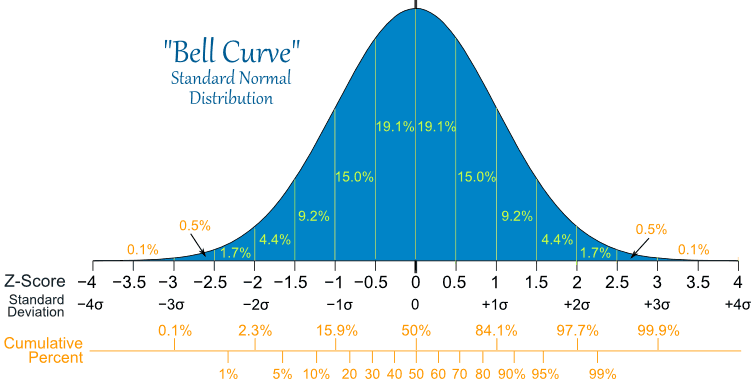


The bell curve accurately describes variations in student marks and student heights, many manufacturing processes, and even the daily movements in the stock market, but it doesn't apply to everything we find in the real world.  For example, simple everyday events such as wait times at your grocery store checkout or bank teller, hospital inpatient length of stay, and the duration of telephone calls do not follow a bell curve.  These events follow an exponential distribution.

What Is An Exponential Distribution?


Exponential distributions are asymmetrical (i.e. skewed to one side of the mean), limited on one side by a minimum (usually zero), and have long tails.  In other words, events far from the mean can and do happen with much more frequency than in normal distributions.

My graph on the left shows one type of exponential family of curves called the Erlang Distributions, named after a Danish telephone engineer A. K. Erlang who began using them in the early 1900's.  These in turn are part of a larger family of exponential functions that engineers call Gamma Functions.

What Erlang discovered is that duration of telephone calls did not follow a normal distribution.  You could not have a call of zero duration or less (i.e. a minimum), but you could have an occasional telephone call that lasted hours (i.e. no practical maximum).  Erlang's job was to accurately predict how much switchboard capacity was required, which he ultimately succeeded in doing.

Because of these occasional large-value events, the rules of normal distributions do not apply.  For instance, you cannot presume that 99.7% of your events will fall within 3 sigma of the mean.  Depending on the specific shape of the exponential distribution, a measurable and significant portion of the events will fall far past 3 standard deviations from the mean, and Erlang had to take those events into account when planning his capacity.

JPMorgan's Mistake

As stated in the article, JPMorgan got into the business of complex credit swaps and assumed they would behave according to a normal distribution.

"Credit default swaps simply don’t behave in line with the normal, or Gaussian, distribution typically assumed. The so-called tail risks, or the chances of extreme events, are bigger than that theory predicts. Ina Drew, who ran the CIO, referred to one day’s mark-to-market losses as an eight standard deviation event, according to the report. That translates mathematically into something that should only happen once every several trillion years. It makes no more sense than Goldman Sachs finance chief David Viniar’s famous remark as the crisis unfolded in 2007 about seeing 25 standard deviation events, several days in a row."

Of course, the mathematics DOES predict this if you use the correct exponential distribution.  The credit swaps had very large potentials for one-day losses, which veer far away from the daily means, but those potentials were either ignored or just presumed to never exist.  JPMorgan failed to recognize the correct distribution for their credit default products and when losses mounted they just blamed mathematics for their wrong assumption.

One cannot simply ignore the rare-but-large-value events.  JPMorgan learned the hard way that with exponential distributions, the tail wags the dog.

And so JPMorgan shareholders are out $6.2 billion for that little mathematics oversight.  Oops.

Friday, 29 July 2011

Risk Management: Connecting Consequences with Decisions

I came across two articles recently whose themes on risk management intersected nicely.

The first article called “Avoiding Another Great Recession” is by a professor at London Business School named Julian Birkinshaw. He correctly attributes the market crash of 2007 to a huge failure in decision-making at some of the largest US banks, and that this particular problem has not yet been addressed. The risk of it repeating therefore remains high. His solution is to personalize the risk evaluation process in large companies. In his words, personalization “involves pushing the responsibility for evaluating and making a judgment around risk to those individuals who are making decisions – and requiring them to live with the consequences of those decisions.” He cites Goldman Sachs and JP Morgan Chase as examples of banks who have this personalization culture in place, and how they fared much better through the crash than other banks.

The second article in the Financial Post had the catchy title, “Why Swiss Banks Don’t Go Broke.” Richard W. Rahn explains how Swiss banks, particularly privately-owned Swiss banks, rode through the financial crisis so much better than banks in other countries. “Banks that are organized as general partnerships have had fewer problems because the partners have a very strong vested interest not to take on risks they do not fully understand because it is they who take the hit if something goes wrong.” Rahn goes on to propose an impractical solution called “mutual fund banking” but the rest of his article stands on its merits.

Bottom line: If you personally stand to lose everything from a careless investment decision, you tend to make fewer careless investment decisions!

As simple as this concept appears, it apparently has not been considered by governments when it comes to fixing the banking system. Governments prefer to believe that increasing and formalizing bureaucracy around these risk management processes will somehow reduce risk. The track records prove otherwise. Managing risk by increasing bureaucracy rarely seems to work. The Basel Accords are a good example.

Global central bankers set up the first Basel accord in 1988 to measure credit risks and to ensure banks retained sufficient reserves to cover those risks. Apparently this higher reserve requirement prompted JP Morgan to use credit default swaps to practically get around that requirement, and later those types of swaps played a significant role in the Lehman Brothers collapse in 2008. Warren Buffet predicted this danger in 2003, calling these swaps and other derivatives like them “financial weapons of mass destruction.”

Basel II was released in 2004 in an attempt to not only tackle credit risk, but other types of risk such as operational market, pension, and liquidity risk. It also failed to prevent the meltdown of 2007.

So, the solution to these regulatory failures? Basel III, currently in development. Just close your eyes, click your heels together three times, and it will be sure to succeed where its predecessors failed!

The failure of the Basel Accords is not in its content or a lack of expertise that went into it, but in its fundamental assumptions. Like Rahn points out, forcing banks to increase their reserves does not reduce the risk of their investments. To be safe, reserves must exceed the level of investment risk, which varies between banks and over time. There is no arbitrary reserve percentage that is safe enough. Safety comes in avoiding poor investments.

As a self-employed business owner, managing risk involves one person so it's not complicated. However, we're not immune from bad financial decisions either. I recently heard about a self-employed contractor who traveled a lot, but did not stay in the expensive hotels that his fellow self-employed contractors did. His comment: "They're spending money like it's not their own company."

And that's what it all boils down to: People have to make decisions like it's their own company, and then they have to experience both the rewards and consequences of those decisions like it's their own company.